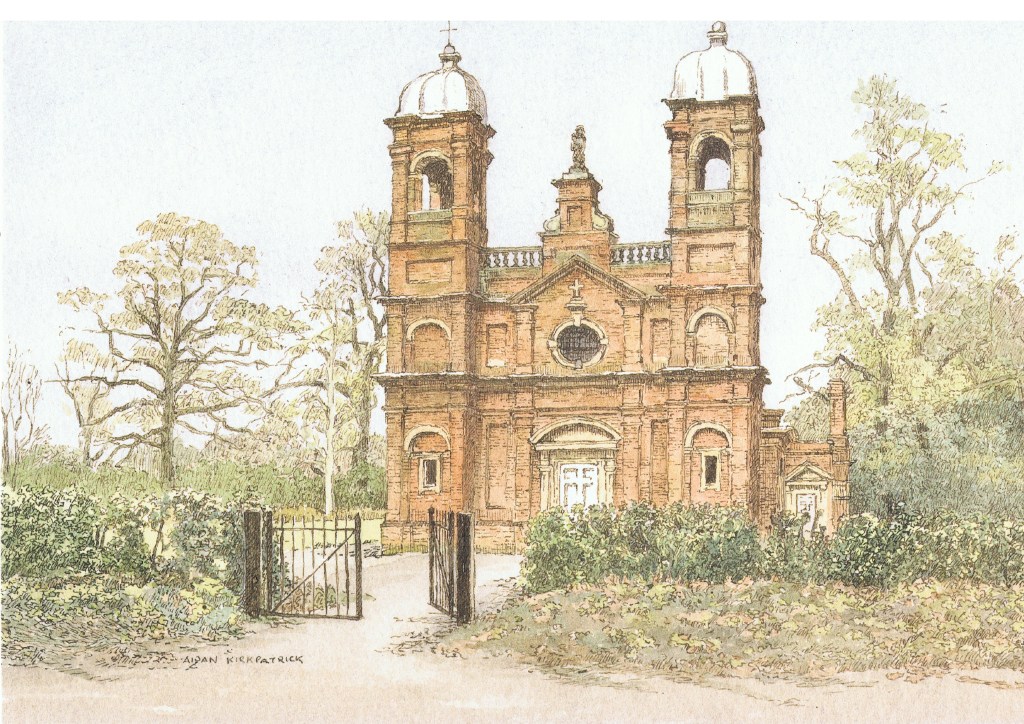
Our church was founded by John George Kenyon (11 October 1843 – 28 July 1914).
Our Lady of Perpetual Succour was opened on Thursday, 18th August, 1898. A local news report of the time (23rd August 1898) explains in great detail the excitement and happiness of that day.
We celebrated our Centenary in 1998.
The church takes its name from a famous icon from 1499, a copy of which may be found to the right of the altar.
The Benedictine Mission in the Waveney Valley: A Timeline
1657: The last year of Oliver Cromwell’s dictatorship. The Tasburgh family are recusants. Richard Tasburgh, an old St Gregory’s (i.e. Downside) pupil, inherits Flixton Hall. He invites Dom. William Walgrave, a monk of St Gregory (i.e. a Benedictine monk from Downside) to minister secretly to the few Catholics in the locality, beginning an association with the Benedictine monks of St Gregory’s (Downside) which continues to the present day, having survived the vagaries of 350 years, a record which must be almost unique among English Catholic parishes. The Tasburgh family continue to house and support a succession of monk-priests, most of them Gregorians.
1678: The Popish Plot: Richard Tasburgh is implicated in the fictitious Popish Plot, but later acquitted.
1688: The Great Fire of Bungay: the Tasburghs are suspected of involvement in the fire due to their Catholic sympathies, since the night before the fire, pieces of rue were allegedly laid on the doors of several houses. In fact, the Tasburghs are foremost in affording relief to the panic-stricken inhabitants of the town.
1704: The Tasburgh family formally establish the Flixton Mission.
1791: The Catholic Relief Act makes it possible for the Tasburghs to build a small chapel and presbytery in Bungay.
1885: Fr. Ephrem Guy arrives in Bungay.
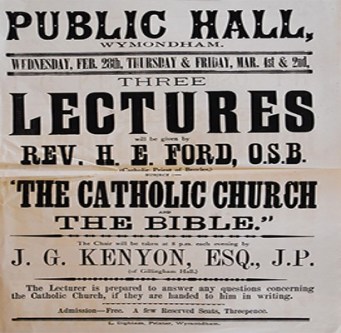
1887: Abbot Snow sends Fr. Ephrem an assistant, Fr. Edmund Ford, who is specially charged with starting the mission at Beccles. Fr. Ford becomes Parish Priest at Beccles, where there are just three registered parishioners. Fr. Ford runs a series of intellectual lectures, chaired by John George Kenyon (a Papal Chamberlain and our Founder), which attract not only Beccles’ nascent Catholics, but local Protestants and other denominations alike. Reviews of Fr. Ford’s lectures seem favourable, and suggest a well-rounded and reasonable approach, even on controversial topics.
1889: A temporary chapel and Residence are acquired at Beccles: ‘Rookwood’, a house on the corner of Peddars Lane and Hungate (now flats). On 3rd November 1889 the first Mass since the Reformation is celebrated in Beccles. After the ceremony, John George Kenyon entertains a large party at The King’s Head. This is the year that John George Kenyon unexpectedly inherits Gillingham Hall and the Gillingham Estate from his aunt, Mrs Eden.
1894: Fr. Ford is appointed Abbot of Downside, and returns to Downside, where he continues his successful lecture series. Fr. Meinred Fulton succeeds as Parish Priest at Beccles, which now has more than 300 parishioners.
1898: Our Lady of Perpetual Succour, Gillingham, is built and dedicated.
1949: A Catholic parish is established at Diss.
1998: Our Lady of Perpetual Succour, Gillingham celebrates its Centenary.
2007: The 350th anniversary of the of the start of the Benedictine Mission in the Waveney Valley is celebrated with a large outdoor Mass and celebration at Bungay on 8th July.
2020: During lockdown, the church interior was thoroughly renovated, the altar and baldacchino each benefitting from specialist restoration by skilled local artist Kim Sisson.
2023: The Benedictine Mission in the Waveney Valley comes to an end, as the monastery of Downside recalled Father Martin Gowman OSB back to the Abbey before the community itself relocated to Belmont Abbey in Herefordshire.
Further links
- For more information about the Regina Coeli prison at the time of John George Kenyon’s imprisonment, please see the thesis by Olga Touloumi, The prison of Regina Coeli : a laboratory of identity in the Post-Risorgimento Italy, MIT, 2006
- For a full account of the origins and history of the Benedictine mission in Bungay, which puts Benedictine activity in Beccles and its environs in context: Slender Thread, Edward Crouzet, Downside Abbey Books, 2007 (ISBN: 978-1-898663-16-4)
- We are mentioned (p.249) by Gordon J. Beattie in Gregory’s Angels: A History of the Abbeys, Priories, Parishes and Schools of of the Monks and Nuns Following the Rule of Saint Benedict in Great Britain, Ireland and Their Overseas Foundations: to Commemorate the Arrival of Saint Augustine in Kent in 597 AD, Gracewing Publishing, 1997
- You can find our more about the fascinating history of Catholicism in East Anglia on the East Anglian Catholic History Society website
